
Fuel Economy
Improving Fuel Economy
Fuel economy depends on several conditions, including driving conditions, your driving habits, the condition of your vehicle, and loading. Depending on these and other conditions, you may or may not achieve the rated fuel economy of this vehicle.
Maintenance and Fuel Economy
You can optimize your fuel economy with proper maintenance of your vehicle. Always maintain your vehicle in accordance with the messages displayed on the multi-information display. • Use the recommended viscosity engine oil, displaying the API Certification Seal. • Maintain the specified tire pressure. • Do not load the vehicle with excess cargo. • Keep your vehicle clean. A buildup of snow or mud on your vehicle's underside adds weight and increases wind resistance.
Improving Fuel Economy
Direct calculation is the recommended method to determine actual fuel consumed while driving.
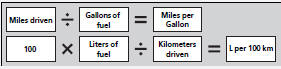
In Canada, posted fuel economy numbers are established following a simulated test. For more information on how this test is performed, please visit http://oee.nrcan.gc.ca/
See also:
Trunk Main Switch
The trunk main switch disables the trunk
release button on the remote transmitter and
the trunk release button on the trunk lid to
protect luggage in the trunk.
1. Make sure the rear seat-back i ...
Opening and Closing the Windows
Opening/Closing the Power Windows
The power windows can be opened and closed when the power mode is in ON,
using the switches on the doors. The driver's side switches can be used to open
and
clos ...
If the Low Oil Pressure Indicator Comes On
Reasons for the indicator to come on
Comes on when the engine oil pressure is low.
What to do as soon as the indicator comes on
1.Immediately park the vehicle in a safe place.
2. If necessary, t ...
